
Getting a referral to a pediatric spine surgeon can feel overwhelming, especially if
your child just had a school screening flag something, or your pediatrician mentioned a
curve for the first time. Knowing what to expect at your first appointment takes a lot of
the uncertainty away. Here’s a step-by-step breakdown.
Before the Visit: What to Bring
If your child has had any prior imaging, X-rays or MRIs, bring those films or discs. If
a school screening report was provided, bring that too. A brief family history is helpful:
scoliosis has a genetic component, and knowing whether a parent or sibling was treated
makes a difference.
The Physical Examination
The visit starts with a thorough physical exam. The spine surgeon will observe your
child’s posture from multiple angles; front, back, and side, looking for:
- Shoulder height asymmetry – one shoulder sitting higher than the other
- Scapular prominence – one shoulder blade protruding more than the other
- Waistline asymmetry – unequal flank creases or hip elevation
- Trunk shift – the head and torso shifted to one side relative to the pelvis
- Sagittal alignment – the natural front-to-back curvature of the spine, assessing
for flatback or excessive kyphosis
The surgeon will also perform a neurological assessment; checking reflexes, muscle
strength, sensation, and gait – to ensure there are no neurological concerns that would
change the evaluation or prompt additional imaging.
The Adam’s Forward Bend Test
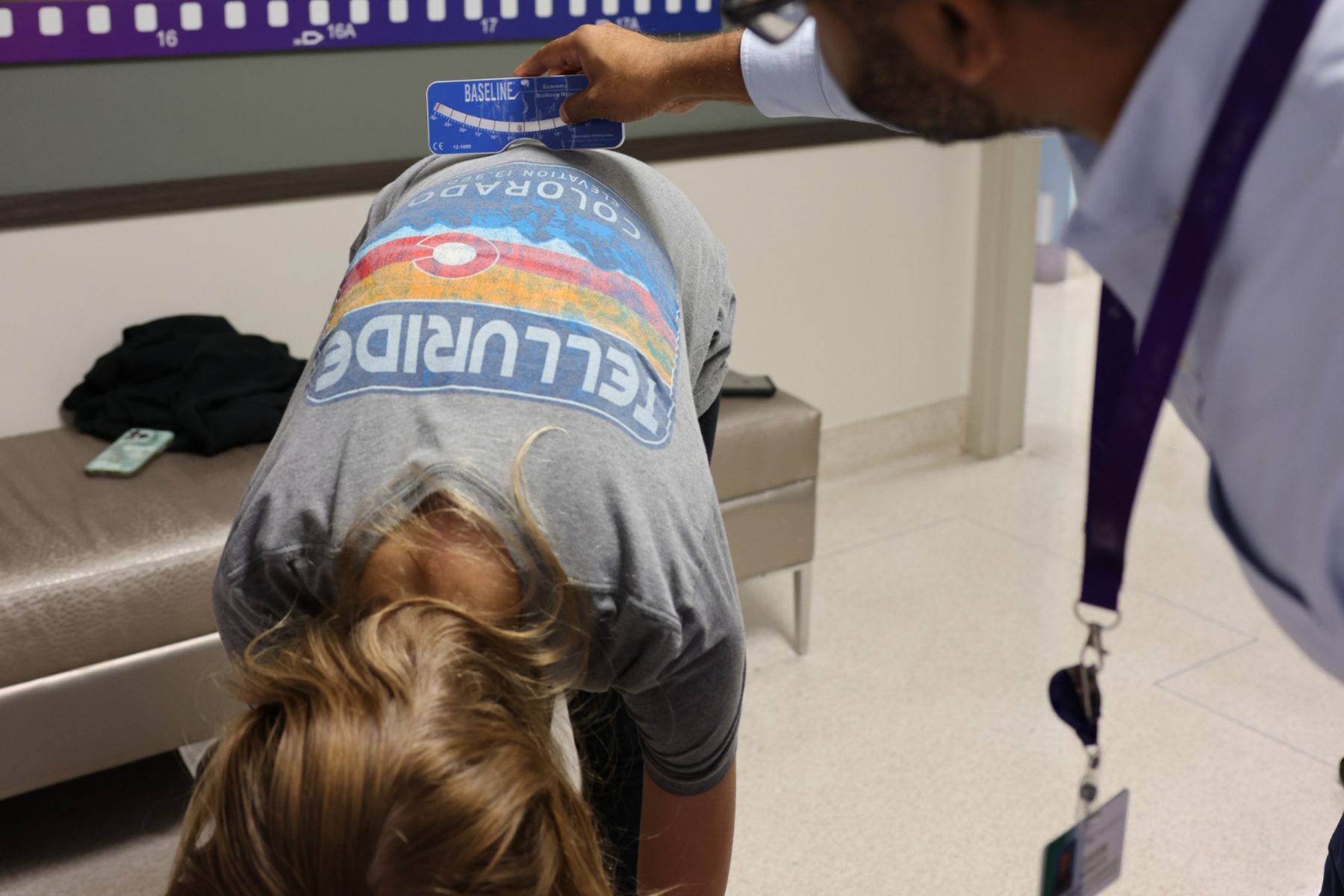
This is the most important part of the physical exam for scoliosis. Your child bends
forward at the waist with knees straight and arms hanging free. The examiner looks
across the back from behind, checking for a rib hump (thoracic rotation) or a lumbar
prominence (lumbar rotation). An inclinometer or scoliometer may be used to quantify
the degree of trunk rotation.
A positive forward bend test with significant trunk rotation is a reliable indicator of
underlying spinal curvature and will prompt X-ray imaging.
Imaging: The Standing Spine X-Ray
The gold standard for scoliosis diagnosis is a standing full-length posteroanterior (PA)
spine X-ray, a front-to-back view that captures the entire spine from the cervical
region down to the pelvis. Standing is important because lying down can allow curves to
partially reduce, underestimating true curve magnitude.
Modern scoliosis imaging increasingly uses low-dose systems (such as EOS imaging)
that dramatically reduce radiation exposure compared to conventional X-ray, an
important consideration for young patients who may require many imaging studies over
years of follow-up.
A lateral (side-view) X-ray is also obtained to assess sagittal alignment, the normal
front-to-back curves of the spine including thoracic kyphosis and lumbar lordosis.
Measuring the Curve: The Cobb Angle
The Cobb angle is the universal measurement used to quantify scoliosis. The surgeon
identifies the most tilted vertebrae at the top and bottom of the curve, draws lines along
their end plates, and measures the angle between those lines.
- Less than 10° – not scoliosis; postural asymmetry
- 10–24° – mild scoliosis; typically observation with interval X-rays
- 25–45° – moderate scoliosis; bracing typically recommended in skeletally
immature patients - Greater than 45–50°.- severe scoliosis; surgical evaluation is indicate
The Cobb angle is not the only number that matters. The curve’s location (thoracic vs.
lumbar), pattern (single vs. double), flexibility, and rotation all factor into the overall
assessment.
Assessing Skeletal Maturity
Because scoliosis tends to worsen during periods of rapid growth, knowing how much
growth your child has remaining is critical. Two common methods are used:
- Risser grade – a measurement of iliac crest apophysis ossification seen on
spine X-rays, graded 0–5 (0 = significant growth remaining; 5 = skeletally mature) - Sanders classification – assesses hand bone maturity (metacarpals and
phalanges) and is particularly useful in pre-menarchal girls, providing finer
granularity during the period of maximum curve risk
Skeletal maturity directly influences whether bracing is appropriate and how urgently a
surgical consultation should proceed.
When Is MRI Ordered?
MRI is not routinely required for straightforward adolescent idiopathic scoliosis.
However, it is recommended in specific situations: left thoracic curves (atypical pattern),
rapidly progressive curves, neurological symptoms or abnormal findings on exam, male
patients with early-onset curves, congenital scoliosis (to evaluate the spinal cord), and
any curve suspected to have an intraspinal etiology such as a Chiari malformation or
syrinx.
At the End of the Visit: The Plan
After the exam and imaging, the surgeon will present a clear picture of the diagnosis
and a recommended management plan; whether that’s observation with interval X-
rays, a brace referral, or surgical consultation. The first visit is also the right time to ask
every question you have. Nothing is too small.
The Bottom Line
A first scoliosis visit is straightforward, non-invasive, and focused on getting accurate
information. The exam and X-rays together give your surgeon everything needed to
classify the curve, understand the risk of progression, and build a plan. Early, accurate
diagnosis leads to better outcomes, and your first visit sets that foundation.
Dr. Arun Ramaswamy Hariharan is a pediatric spine surgeon at the Paley Institute at St. Mary’s
Medical Center in West Palm Beach, FL, specializing in adolescent idiopathic scoliosis, early
onset scoliosis, and complex spinal deformity. To schedule a consultation, visit
scolisurgeon.com.