Bracing is the cornerstone of non-surgical management for moderate scoliosis in
skeletally immature patients. When used correctly, it’s one of the most effective tools
available to prevent curves from progressing to surgical thresholds, but its success
depends heavily on the right patient, the right brace, and consistent compliance.
Who Is Bracing Appropriate For?
Bracing is recommended when three conditions are met: the curve is in the moderate
range (typically 25–45 degrees Cobb angle), the patient has significant skeletal growth
remaining, and the curve pattern is appropriate for brace treatment.
Skeletal maturity assessment is central to this decision. Bracing a patient who is nearly
skeletally mature has minimal benefit; the goal of bracing is to prevent progression
during the remaining growth period. A patient who is Risser 0 or 1 (significant growth
remaining) with a 28-degree curve has a very different risk profile and a very different
potential benefit from bracing than a Risser 3 patient with the same curve.
Curves under 20–25 degrees are generally observed without bracing. Curves over
45–50 degrees in growing patients typically warrant surgical consultation, as bracing is
unlikely to maintain a curve of that magnitude.
How Does a Brace Work?
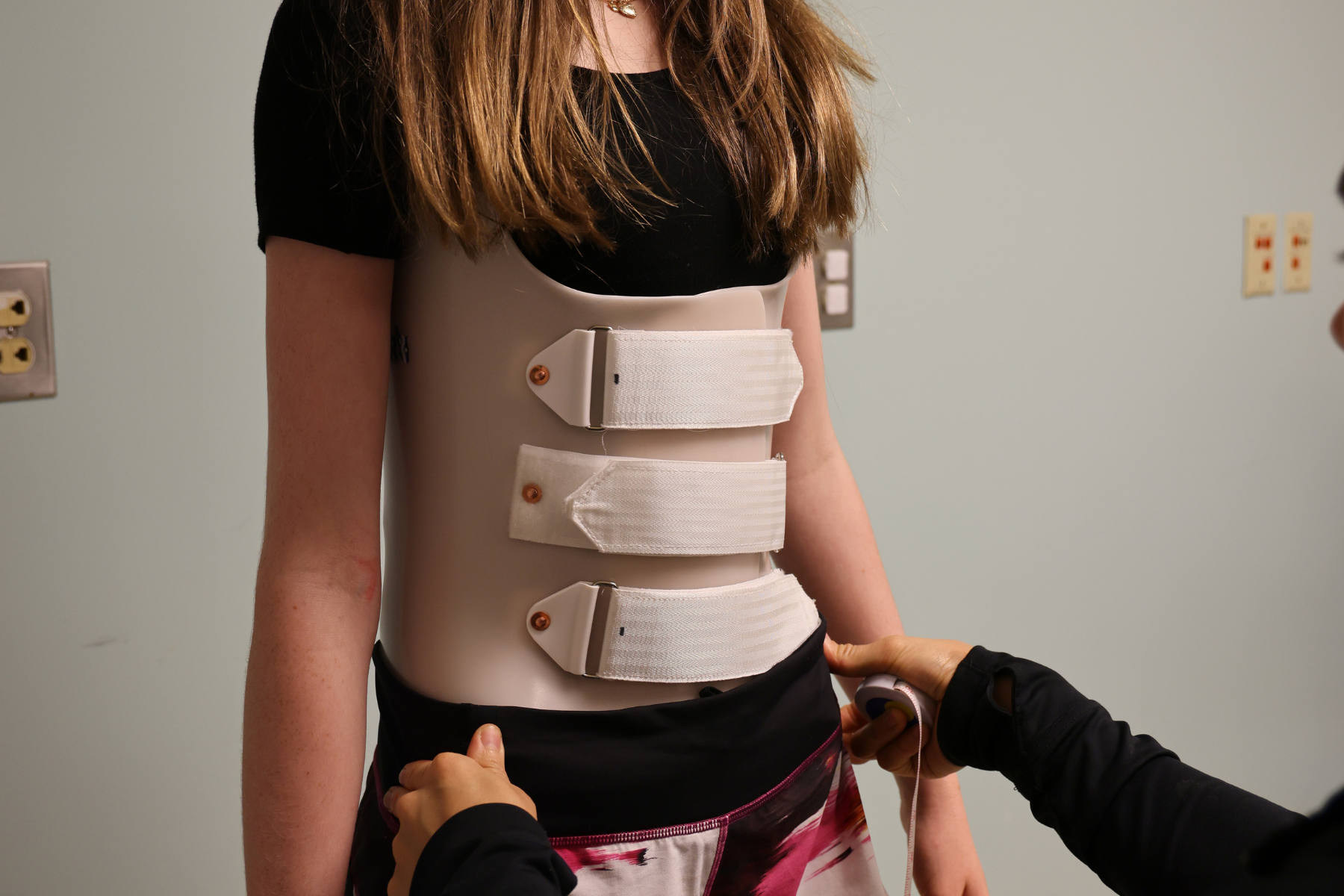
A scoliosis brace works through lateral pressure, strategically placed pads apply
forces to the spine at specific points, redirecting the curve and reducing the Cobb angle
while the brace is worn. In a well-fitted brace, in-brace correction of 50% or more is
considered an excellent result and correlates with better long-term outcomes.
Importantly, the brace is not attempting to permanently straighten the spine. Its goal is
to hold the curve stable during the remaining growth period, preventing it from crossing
the surgical threshold.
Types of Braces
Several brace designs are used for adolescent idiopathic scoliosis:
• Boston brace — An underarm (thoracolumbosacral orthosis / TLSO) brace that is
one of the most widely used. Effective for curves with an apex at or below T7.
• Rigo-Cheneau brace — A custom asymmetric TLSO based on three-dimensional
curve anatomy. Increasingly used as evidence for its effectiveness has grown.
• Charleston bending brace — A nighttime-only brace worn while the patient is
bent to the side. Intended for single lumbar or thoracolumbar curves. Worn only
during sleep.
• Providence brace — Another nighttime brace. Used for specific curve patterns
and worn during sleep only.
For most patients with thoracic or double major curves, a full-time TLSO is the standard
recommendation.
How Many Hours Per Day?
This is the most important variable in bracing outcomes. Research, including the
landmark BRAIST trial, demonstrated that time in brace is the single biggest predictor
of success. The study found a success rate of approximately 90–93% in patients who
wore their brace 13 or more hours per day, compared to significantly lower rates in
those who wore it less.
Most full-time braces are prescribed for 16–23 hours per day, with time out for bathing
and sports. Nighttime-only braces are prescribed for patients who are appropriate
candidates based on curve pattern and location.
Compliance: The Biggest Challenge
Brace compliance is notoriously difficult, particularly in adolescents who are already
navigating the social pressures of middle and high school. Modern braces are low-
profile, fit under clothing, and are more comfortable than older designs, but they still
present a challenge.
Practical strategies that improve compliance include: educating the patient directly (not
just the parents) about the purpose and evidence behind bracing; using temperature
sensors built into modern braces that objectively track wear time; involving a dedicated
orthotist who can optimize fit and comfort; addressing the psychological dimensions
through peer support groups; and, when appropriate, prescribing a nighttime brace for
patients with suitable curve patterns to reduce daytime visibility.
What to Expect During Bracing
Once bracing begins, your child will be followed with standing spine X-rays every 4–6
months. Initial X-rays are taken both with and without the brace to assess in-brace
correction. The brace will be adjusted or replaced as your child grows. Bracing
continues until skeletal maturity, typically Risser 4–5 in girls, later in boys.
At the end of bracing, the brace is weaned gradually rather than stopped abruptly, and a
follow-up X-ray without the brace confirms the out-of-brace curve magnitude.
Can My Child Still Be Active?
Yes, and they should be. Most children in braces participate in the same activities as
their peers, including sports and physical education. The brace is typically removed for
athletic activities. Exercise, particularly core strengthening and flexibility work, is
encouraged and complements brace treatment.
The Bottom Line
Bracing is effective, non-invasive, and when properly prescribed and consistently
worn, can keep many moderate curves from ever requiring surgery. The key is getting
the diagnosis right, starting bracing at the appropriate time, and supporting your child
through the compliance challenges that are an inevitable part of the process.
Dr. Arun Ramaswamy Hariharan is a pediatric spine surgeon at the Paley Institute at St. Mary’s
Medical Center in West Palm Beach, FL, specializing in adolescent idiopathic scoliosis, early
onset scoliosis, and complex spinal deformity. To schedule a consultation, visit
scolisurgeon.com.